
In recent years I’ve noticed that foods comprised primarily of wheat have been making me feel extremely sick. In addition to the acute symptoms that crop up immediately after ingesting a few slices of pizza, I have generally for the last handful of years felt mildly unwell. More specifically, I have been tired to the point that doing anything has been a substantial physical and mental lift for me. Laying down on the floor to play with my son was easy enough but getting off the floor to follow him as his 2-year-old brain hopped chaotically from task to task was brutal and I never wanted to get up after I had gone down. I didn’t have the energy to get up off the floor without thinking about it. So, I started wondering why it was that I felt so bad, and then I asked myself when was the last time that I truly felt healthy and well? I explored my thoughts for a while, and it dawned on me that the last time I felt healthy was 11 years ago when I was 26.
Are people in their 30’s supposed to feel like shit all the time? We become self-deprecating about our age when we exit our 20’s and a newly minted 30 year will almost invariably start talking about how old they are, even though from a biological standpoint a person’s 30’s corresponds with peak maturity and physical ability. For instance, the upward capacity of a person’s physical output while engaging in endurance sports peaks in their mid to late 30’s. My point is that 30-year-olds aren’t old and being 30 isn’t the point where a person should expect the onset of debilitating physical symptoms related to aging, or any sort of dramatic decline in metabolic function for that matter. 30-year-olds that by all appearances seem healthy shouldn’t feel like shit all the time, and if you’re 30 and you do feel like shit all the time it probably has nothing to do with your age.
Back to bread. Bread makes me feel bad for no apparent reason. As far as I know this wasn’t the case at any point in my life until recently. Making the correlation between eating bread and feeling bad got me wondering if I was becoming a gluten sensitive person, but seriously, how can that be a thing? Gluten has existed in bread products since bread was invented, which was a long time ago. It stands to reason that if humans have been eating bread for perhaps tens of thousands of years, that as a species we would be pretty well adapted to eating and digesting bread. Also no one ever heard of non-celiac gluten intolerance in the last few thousand years. It seems suspicious that an ever-present component of a centuries old human food staple would all the sudden become problematic for a massive portion of the population. Also, anecdotally, I have heard that there aren’t pandemics of gluten intolerance cropping up in other parts of the world. The French and Italians, don’t, as far as I can tell, have a rapidly growing population of people that can’t digest bread. I’ve been to France, and it seemed like they eat bread exclusively, at every meal! The idea that people without celiac disease are becoming intolerant of gluten is fucking hokey at best. The correlation between feeling bad after eating bread and that being caused by gluten is spurious, which is strange considering how ubiquitous and socially accepted that correlation has become. If your unclear what a spurious correlation is the following image is a my favorite example of two unrelated events having a spurious correlation when graphed side by side:
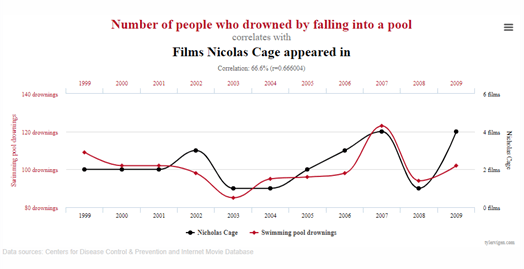
What the fuck is going on then? Bread makes a lot of people feel bad when they eat it, I have no doubt, but there’s no logical equation that would point at gluten as the gastronomically offending component of bread. So then why do so many people believe that they’re sensitive to gluten? Is there anyone that would benefit from this belief? A quick google search returned a fast “yes” to the last question, and sure as shit there are massive corporate interests that benefit greatly from wide spread self-diagnosed gluten intolerance, see below snip of my google search.
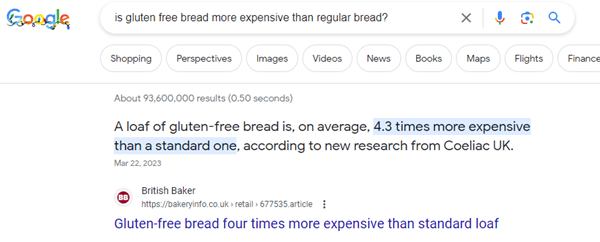
Gluten free Bread is 4.3 times more expensive than regular bread! In business school you learn about a thing called the value chain. It’s basically a way to look at who makes money and how they make that money as raw materials are converted into end products. There are not many steps on the wheat grain to bread value chain, and the margins for everyone involved are small, so if you can add in a bunch of unnecessary steps that have a perceived value for the end user you can hypothetically make a bunch more money. This only works if the perceived value confers a perceived benefit to the end user, and I assume that people aren’t being made ill by gluten free breads. If you feel fine after you eat gluten free bread and gluten rich bread makes you feel like crap, it must be that you’re sensitive to gluten.
Stash the following snippet away in your mind, it won’t make sense until the end of the article:
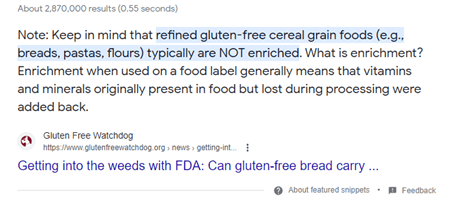
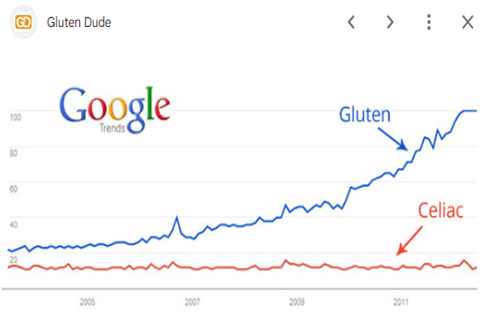
I would wager my last shinny nickel that, save for people with celiac disease, almost nobody is intolerant of gluten, and the reason we believe that gluten intolerance is real is that there is so much money to be made by removing gluten from bread, and the folks that make that money have committed a ton of effort into getting you to believe that gluten is bad for you. The next graph is for effect, it represents the rise of gluten free products against the extremely static prevalence of Celiac Disease in the population.
Gluten is not a problem, but I still feel bad when I eat bread, so what the hell is the problem? Is it because the crops that we eat are sprayed with pesticides? Maybe, here’s a graph of Gluten intolerance measured against the rise in use of Glyphosate as a pesticide.
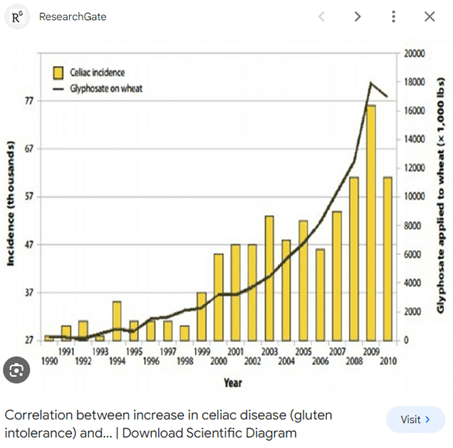
Ingesting poison is always a bad idea, and I have no doubt that glyphosate has some deleterious effect on our health, but if I think about this logically, I feel like there would be a more even distribution of reported gluten intolerance if that perceived intolerance was actually being caused by pesticides. The portion of the population that would be tolerant of ingesting this poison would be on the tail end of the bell curve, and mostly everyone would report feeling like shit after eating grain products. Within my social circle it seems like a noticeable minority of the people I know report gluten intolerance. If actual poison was the culprit, it would be a noticeable majority reporting gluten intolerance. Also, I’m sure that French and Italian farmers use pesticides, and again, those populations don’t have gluten intolerance pandemics. It’s interesting and coincidental that the rise in reported gluten intolerance and the use of glyphosate as pesticide began in 1999. I believe the above graph depicts a spurious correlation, also it makes no sense because gluten intolerance decreased in 1998 all the while glyphosate use was ramping up. A thinking person would expect a spike in gluten intolerance in 1998. The spike didn’t come until 1999, a year with similar glyphosate use to 1998. So, either data collection on gluten intolerance sucked in 1998 or glyphosate wasn’t the ingredient in bread that was making people feel bad.
Something else happened to bread in 1998 that was coincidental the rise in glyphosate use. In 1998 wheat flour producers became legally required to enrich wheat flour with synthetic folic acid, a chemically produced compound that is an analog of Folate. (now if the time to re-reference the earlier out of place snippet about gluten free grain not being enriched) Folate, perhaps better known as vitamin B6, is a critical nutrient for proper cell growth and function. Folate is also a very critical component in fetal development. In utero babies are prone to developing birth defects, specifically neural tube defects like spina bifida, if their mothers aren’t supplying them with enough folate. To reduce neural tube defects in developing fetuses the US government created fortification laws which required certain grain products to be fortified with specific levels of synthetic folic acid. Synthetic folic acid is not folate. Your body uses a couple of different enzymes to convert folic acid into a compound called methyl tetrahydrofolate or more simply (6s)-5-MTHF. About 40% of the human population has a gene mutation that limits or eliminates their ability to produce the enzymes that convert synthetic folic acid into its useable form. For these people synthetic folic acid just floats around in their blood, maybe doing nothing, but probably doing damage.
As a population we eat a tremendous amount of enriched grain, and for 40% of us that means we are being dosed, daily, with a synthetic compound that our bodies can’t do anything with. Every compound that we ingest has a threshold where it becomes toxic to us, think about water intoxication if that statement sounds fishy to you (water is toxic?). Compounds that your body can’t metabolize are especially toxic, think about mercury. If something as benign and necessary as water can be toxic at a high enough dosage, then I don’t think it’s unreasonable to assume that unmetabolized synthetic folic acid floating around in a person’s blood is also very likely to be toxic.
Think about it for just a minute. Doesn’t it kind of feel like 40% of the people you know claim some degree of gluten intolerance? It kind of does, doesn’t it?
What does the internet suggest a person do if they suspect they are being poisoned with synthetic folic acid? The internet suggests that you refrain from eating enriched grain products, and or begin supplementing your diet with the useful version of folate. (6s)-5-MTHF is an inexpensive and easily acquired B vitamin. Best of all your body doesn’t have to perform any enzymatic processes to use (6s)-5MTHF, it’s ready for your cells to use as soon as it enters your blood stream.
2 weeks ago, I started taking two of these every day:

I don’t get any money from Thorne Research, so don’t worry about that. 2 weeks out and I am experiencing something strange. Something I haven’t experienced in 11 years. I feel good. Mentally and physically. I can chase my two-year-old around with little effort. I’m reengaging socially and making new friends. I also ate 3 donuts the other morning and they didn’t make me feel like shit. I have no idea what is going on metabolically, or how this B complex is perhaps acting to mitigate the ill effects of synthetic folic acid in my body, but holly shit the difference in my perceived health is night and day. I’m no expert and my experience is anecdotal, but if you’re feeling like crap all the time, especially after eating grain products, you probably aren’t gluten intolerant, and you might give a b-complex vitamin a shot. Aging doesn’t mean that you feel shitty all the time, don’t get that confused, you can feel good and get old at the same time. If you do feel shitty all the time it might be that someone’s good intentions are poisoning you by accident. So, take your vitamins, and go have some bread!
 DylanPearce.org
Leave a comment